
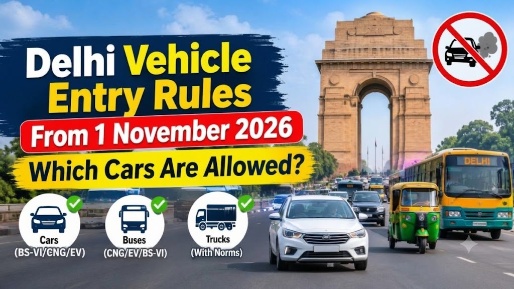
Planning to drive into Delhi on or after November 1, 2026? Check your vehicle’s emission standard before you set off. The Delhi Traffic Police has issued an advisory on vehicle entry under the revised Graded Response Action Plan (GRAP), and vehicles that don’t meet the rules could be stopped at the borders.
Here’s the short version. BS-VI vehicles, CNG vehicles, electric vehicles (EVs), and vehicles covered by notified exemptions can enter Delhi, subject to the applicable rules. Many older vehicles registered outside Delhi will not get in. The advisory also says that even BS-VI vehicles need a valid Pollution Under Control Certificate (PUCC) to enter. Here’s a simple breakdown of the Delhi vehicle entry rules, so you know what to check before you travel.
Delhi Vehicle Entry Rules: What Changes From November 1?
The new restrictions take effect on November 1, 2026. They are part of Delhi’s winter pollution-control plan and the revised GRAP, which the Commission for Air Quality Management (CAQM) approved on September 28, 2026.
The idea is simple: keep older, high-emission vehicles from outside the city off Delhi’s roads during the months when the air is at its worst. Vehicles will be checked for emission standards, fuel type, and exemptions.
Here are the key points:
- BS-VI, CNG, and electric vehicles can enter, subject to applicable rules.
- Non-BS-VI vehicles registered outside Delhi are barred from November 1, 2026, to January 31, 2027, with some exemptions.
- Buses entering Delhi must run on electricity, CNG, or BS-VI diesel, under CAQM directions.
- Commercial goods vehicles registered outside Delhi must be BS-VI, CNG, LNG or electric.
- Even BS-VI vehicles need a valid PUCC, and vehicles without one can be refused fuel.
Which Cars Can Enter Delhi?
If you drive a private car registered outside Delhi, this is the section that matters most for you. Vehicles registered outside Delhi that fall below BS-VI standards will not be allowed in between November 1, 2026, and January 31, 2027. That includes older BS-III and BS-IV petrol and diesel vehicles. CNG and electric vehicles are exempt from this restriction. So are ambulances, fire services, and other essential vehicles covered by the notified exemptions.
| Vehicle Category | Entry Status |
| BS-VI petrol or diesel cars | Allowed, subject to a valid PUCC and other rules |
| Electric cars | Exempt from the entry restriction |
| CNG cars | Exempt from the entry restriction |
| Non-BS-VI petrol or diesel cars registered outside Delhi | Not allowed from Nov 1, 2026 to Jan 31, 2027 |
| Ambulances, fire services and other notified essential vehicles | Exempt, as per the notified exemptions |
Vehicles registered in Delhi aren’t covered by this particular restriction. Authorities are tightening checks at the borders using Automatic Number Plate Recognition (ANPR) cameras, AI-powered surveillance and physical checks. Around 300 transport department enforcement personnel are also being deployed.
Bus Entry Rules: Which Buses Can Enter Delhi?
Under CAQM directions, buses entering Delhi must run on electricity, CNG, or BS-VI diesel. Buses that don’t meet this standard can be stopped at the border, so if you’re booking intercity travel, it’s worth asking the operator which type of bus is running.
Truck and Commercial Vehicle Entry Rules
Transporters need to pay attention here, because the rule for goods vehicles is stricter. Under the CAQM direction, commercial goods vehicles registered outside Delhi that are not BS-VI compliant are barred from entering the city from November 1. This covers light, medium and heavy goods vehicles. Only BS-VI, CNG, LNG and electric goods vehicles are allowed in. Goods vehicles registered in Delhi are not covered by this restriction.
Two relaxations have also run out. BS-IV goods vehicles were allowed in only as a transitional measure until October 31, 2026. The limited exemption for vehicles carrying essential commodities also ended on October 31, 2026.
If your truck isn’t headed for Delhi, the advisory asks you to use the peripheral expressways instead of passing through the city.
No PUC, No Fuel: What Drivers Should Know
Your PUC matters at two points: at the border and at the fuel pump. Under the ‘No PUC, No Fuel’ rule, vehicles without a valid Pollution Under Control Certificate will not be given petrol, diesel, CNG, or LPG at fuel stations in Delhi. CAQM’s Direction No. 101 applies the rule across the NCR from October 1, 2026, and it is also listed among Delhi’s winter-plan measures from November 1. Around 500 Delhi fuel stations use number plate cameras to check PUCC status.
On top of that, the Delhi Traffic Police advisory says even BS-VI vehicles won’t be allowed to enter without a valid PUCC. So check your certificate’s expiry date now and renew it if needed.
What Is GRAP, and How Does It Connect to These Rules?
GRAP stands for the Graded Response Action Plan. It’s a set of emergency measures that CAQM brings in for Delhi-NCR, with stricter steps as air quality gets worse. The revised GRAP rules 2026 have 48 actions across four stages: 25 in Stage I, 8 in Stage II, 10 in Stage III, and 5 in Stage IV.
| GRAP Stage | AQI Category | AQI Range |
| Stage I | Poor | 201–300 |
| Stage II | Very Poor | 301–400 |
| Stage III | Severe | 401–450 |
| Stage IV | Severe+ | Above 450 |
There’s one thing worth keeping straight. The winter entry restriction for non-BS-VI vehicles runs on fixed dates, from November 1, 2026, to January 31, 2027. Other GRAP measures depend on the air quality at the time, and earlier-stage measures stay in force when a higher stage is invoked. So check which stage is active before you travel.
Final words
The new Delhi vehicle entry rules from November 1, 2026, will affect private car owners, bus operators and truck drivers alike. BS-VI, CNG and electric vehicles can generally get in, while older non-BS-VI vehicles registered outside Delhi, and non-compliant buses and goods vehicles, face restrictions. Before you travel, check your vehicle’s emission standard, where it’s registered, and whether your PUCC is valid. A few minutes of checking now can save you a turn-back at the border.
FAQs
- When will the new Delhi vehicle entry rules come into effect?
The new vehicle-entry restrictions will come into effect on November 1, 2026, as part of Delhi’s winter pollution-control measures.
- Can BS-IV petrol and diesel cars enter Delhi from November 1?
Non-BS-VI private vehicles registered outside Delhi will face entry restrictions from November 1, 2026, to January 31, 2027. CNG and electric vehicles are exempt from this particular restriction.
- Are BS-VI diesel cars allowed in Delhi?
Yes. BS-VI diesel vehicles are permitted under the new emission-based entry rules, subject to valid documents and other applicable requirements.
- Which buses will be allowed to enter Delhi from November 1?
CNG, electric, and BS-VI diesel buses will be permitted. Interstate buses below the required emission standards will be stopped or diverted. Delhi-registered buses are exempt from this particular restriction.
- Can old trucks enter Delhi from November 1?
Outstation goods vehicles must meet the applicable emission and fuel requirements. Trucks that do not meet the prescribed conditions may be denied entry.
- What is the No PUC, No Fuel rule in Delhi?
Under this rule, vehicles without a valid Pollution Under Control Certificate will be denied fuel at petrol pumps from November 1, 2026.