
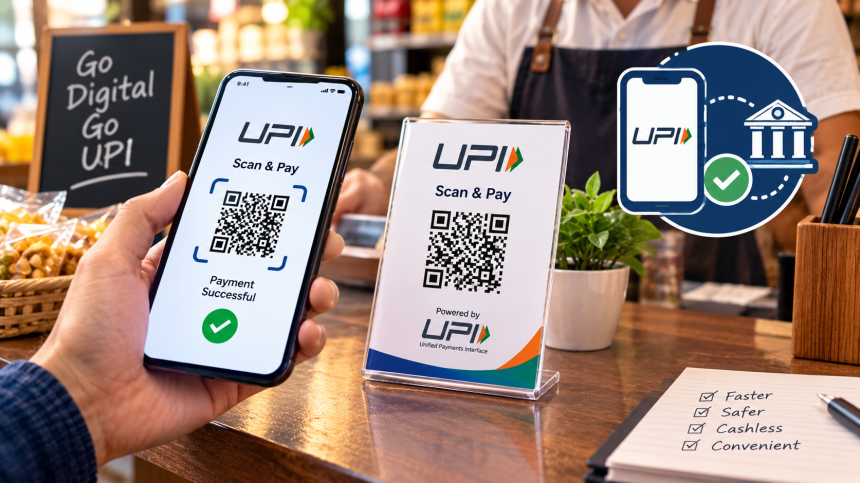
If you use UPI every day, you’ve probably wondered whether your payments will start costing you more from October 15, 2026. Here’s the short answer: no, you won’t directly pay a UPI transaction fee under the new Merchant Discount Rate (MDR) framework.
From October 15, a new MDR will apply to certain Person-to-Merchant (P2M) UPI transactions above ₹2,000. In most cases, the merchant pays it, not you. Person-to-Person (P2P) payments stay free, and the government has also said banks should make sure merchants don’t pass the MDR on to customers.
That said, there’s a bit more to the story. Some sectors have different rates, eligible small merchants get exemptions, and larger transactions come with a maximum MDR of ₹300. Let’s walk through it.
What Is Changing From October 15?
Under the new framework, a 0.4% MDR will apply to eligible P2M UPI transactions above ₹2,000. So what’s MDR? Merchant Discount Rate is simply a fee for processing certain digital payments. The merchant pays it to the entities involved in handling the transaction. It isn’t charged to you at the checkout.
Here’s how it plays out in real life:
- ₹1,500 UPI payment to a merchant: No MDR
- ₹2,000 UPI payment: No MDR
- ₹10,000 eligible merchant payment: 0.4% MDR, or ₹40
- ₹50,000 eligible merchant payment: 0.4% MDR, or ₹200
- ₹75,000 or more: MDR capped at ₹300
So even if your payment crosses ₹2,000, you won’t suddenly see a separate fee pop up on your payment screen.
Will Customers Pay More for UPI?
No, not under the announced MDR framework. The Ministry of Finance has said consumers won’t face transaction charges. P2P transactions will also stay free, no matter how much you send. Banks have also been advised to make sure merchants don’t push the new MDR cost onto customers.
In plain terms: if you buy something worth ₹10,000 from an eligible merchant and pay by UPI, you should still pay ₹10,000, not ₹10,040 because of MDR. In that example, the ₹40 is the merchant-side MDR. It’s the shop’s cost, not yours.
How Does the 0.4% MDR Work?
The standard MDR for eligible P2M payments above ₹2,000 is 0.4%. Here’s a quick look at what that means at different amounts:
| UPI Payment | Standard MDR at 0.4% |
| ₹2,000 | ₹0 |
| ₹3,000 | ₹12 |
| ₹5,000 | ₹20 |
| ₹10,000 | ₹40 |
| ₹25,000 | ₹100 |
| ₹50,000 | ₹200 |
| ₹75,000 | ₹300 |
| ₹1,00,000 | ₹300 cap |
The ₹300 ceiling really matters for bigger payments. At ₹75,000, 0.4% works out to exactly ₹300, and anything above that stays subject to the ₹300 maximum under the standard structure.
What Is the ₹2,000 Threshold?
The ₹2,000 figure is a per-transaction threshold, not a daily limit. In other words, a merchant can keep receiving as many UPI payments of ₹2,000 or less as they like without MDR applying to those individual transactions.
For example, five separate customers each paying ₹2,000 won’t be treated as one ₹10,000 transaction just because the total adds up to ₹10,000 by the end of the day.
What About Small Merchants?
Small merchants get some breathing room too. According to the reported framework, certain small merchants who receive UPI payments straight into their bank accounts through QR codes can stay outside the MDR structure, as long as they meet the prescribed criteria.
The government has stressed that the vast majority of UPI transactions will remain free for merchants. The new MDR only applies to a limited set of higher-value merchant transactions. This is worth remembering: paying more than ₹2,000 doesn’t automatically mean the merchant will be charged MDR. The type of merchant and the transaction category both matter.
Are All UPI Payments Above ₹2,000 Charged at 0.4%?
No. Some specified merchant categories follow a different MDR structure. For example, payments above ₹2,000 in categories such as railways, telecom services, insurance, and fuel can attract a flat ₹5 MDR under the announced framework. A few other specified categories, including certain bill-payment and education transactions, are covered by separate provisions as well. So it’s best not to assume that every ₹10,000 UPI payment will cost the merchant exactly the same MDR.
What About UPI Payments to Friends and Family?
Good news here: P2P UPI payments stay free.Whether you send ₹5,000 to a friend, ₹20,000 to a family member, or make any other eligible person-to-person transfer, the new P2M MDR doesn’t apply. The framework is aimed specifically at selected Person-to-Merchant transactions, not everyday transfers between people.
Why Is MDR Being Introduced?
The government and NPCI say the new structure is meant to support the long-term sustainability of the UPI ecosystem. UPI handles an enormous number of transactions every month, and that creates ongoing needs for infrastructure, cybersecurity, innovation, and customer support. That’s why the new MDR is designed as a merchant-side charge on selected higher-value transactions, rather than a general fee for UPI users.
UPI Charges From October 15: What Users Need to Remember
If you only take away a few things, make it these:
- P2P UPI payments remain free.
- UPI payments to merchants up to ₹2,000 remain outside MDR.
- Eligible P2M payments above ₹2,000 can attract 0.4% MDR.
- The standard MDR is capped at ₹300 for transactions of ₹75,000 and above.
- Eligible small merchants can remain exempt under the prescribed rules.
- Certain sectors have separate MDR rates, including a ₹5 flat charge for specified categories.
- Customers are not supposed to pay the MDR directly.
- The ₹2,000 threshold applies per transaction, not as a daily cumulative limit.
The Department of Financial Services has published the official FAQs on the new UPI MDR framework, dated September 15, 2026.
FAQs
Will I be charged for making a UPI payment above ₹2,000?
No. The announced MDR is a merchant-side charge, and consumers aren’t supposed to pay it directly.
Is UPI still free for payments below ₹2,000?
Yes. P2M payments up to ₹2,000 stay outside the MDR framework.
What is the new UPI MDR rate?
The standard MDR for eligible P2M transactions above ₹2,000 is 0.4%.
What is the maximum UPI MDR?
The standard MDR is capped at ₹300 for transactions of ₹75,000 and above.
Will sending money to another person attract MDR?
No. P2P UPI transactions remain free.
Bottom Line
The biggest takeaway for everyday UPI users is that October 15 doesn’t introduce a direct UPI fee for consumers. The new MDR applies to selected merchant transactions above ₹2,000, and it’s generally the merchant who pays it.
For you as a customer, ordinary UPI payments, including transfers to friends and family and purchases up to ₹2,000, remain free under the announced framework. For merchants, though, higher-value eligible transactions will bring a new processing cost, subject to exemptions, category-specific rules, and the ₹300 cap.