

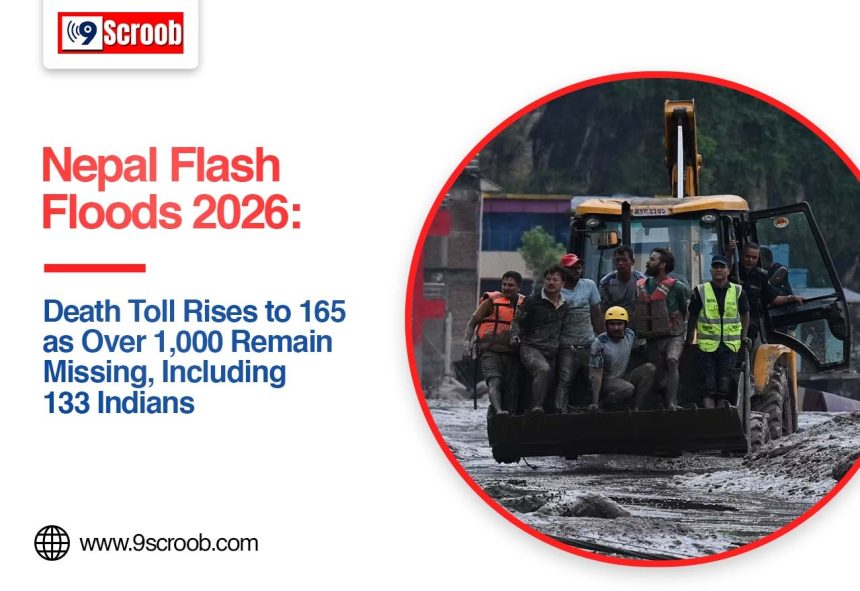
A glacier gave way in Nepal’s Himalayan border region this week, sending a wall of ice, rock, and water crashing down through mountain valleys with almost no warning. At least 165 people have died, and Nepal is now running one of its largest search-and-rescue operations in years. Over 1,000 people are still unaccounted for across Nepal and neighboring Tibet, and that number keeps changing as rescuers slowly reach villages that had been completely cut off.
Among the missing are 133 Indian nationals, many of them pilgrims who had set out on the Kailash Mansarovar Yatra when the disaster struck.
How the Flood Started
At first, it looked like the destruction might have come from an earthquake. It hadn’t. Geologists at the US Geological Survey traced the real cause to something else: a glacier collapse.
A mass of ice and rock broke loose high in the mountains and slammed into a river below. The impact triggered a massive surge of water, mud, and debris that raced downhill through the Bhote Koshi and Trishuli river valleys, flattening homes, roads, bridges, and even hydropower stations before most residents had time to react.
It’s a stark reminder of how unstable the high Himalayas have become. Warming temperatures, fragile glacial ice, and sudden heavy rain are a dangerous mix in a region where entire communities live downstream of terrain that’s remote and nearly impossible to monitor in real time.
The Human Toll Keeps Climbing
Rescue crews are still working to understand the full scale of what happened, and the numbers are shifting by the hour. Here’s where things stand right now:
- 165+ confirmed dead
- 1,000+ people missing across Nepal and Tibet
- 133 Indian nationals and 37 NRIs unaccounted for, including roughly 50 believed to have been on the Kailash Mansarovar pilgrimage
- Missing persons also reported from the US, UK, Australia, and Canada
A group of pilgrims linked to the Isha Foundation is reportedly among those unaccounted for as well.
A lot of the difficulty comes down to geography. Entire stretches of road and several major river crossings have simply been wiped out, leaving some villages reachable only by helicopter. That’s slowed down an already chaotic rescue effort even further.
India’s Response: Aid, Aircraft, and Anxious Families
With so many Indian citizens caught up in the disaster, India moved fast. An Indian Air Force aircraft carrying relief supplies and medical equipment has already landed in Kathmandu, and officials say more support is on the way as coordination with Nepalese authorities continues.
For families back home, though, the hardest part has been the waiting. Communication networks in the affected valleys are patchy at best, and Indian officials have had to actively urge relatives not to trust rumors circulating on social media — and instead rely on updates from government channels and embassies.
Rescue Efforts on the Ground
Nepal has sent its army, police, and armed police force into the disaster zone, with helicopters doing most of the heavy lifting — pulling survivors out and dropping supplies in, since so many roads no longer exist.
It’s slow, dangerous work. Landslides remain a real threat, the terrain is unstable, and rescuers are keeping a close watch on blocked rivers that could unleash a second flood without much warning.
What Comes Next
Right now, the priority is simple: find survivors and give answers to the families still waiting. Search teams are expected to keep combing through the wreckage in the days ahead, while engineers work to reopen roads and restore communication to isolated communities.
For India, locating its 133 missing citizens remains the most urgent task. As rescue teams reach more remote areas, officials expect the casualty and missing-persons numbers to keep changing, and they’re hoping that means more people found alive, not fewer.