
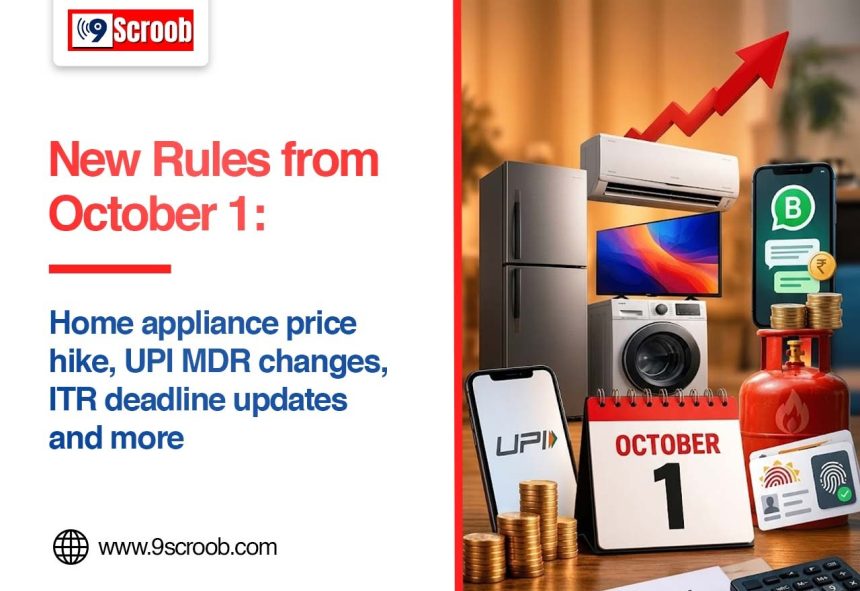
October 2026 brings several important changes that could affect household budgets, digital payments, businesses and taxpayers.
- 1. ACs, TVs and Other Appliances May Become More Expensive
- Can You Still Buy Appliances at Old Prices?
- 2. UPI Merchant Charges From October 15
- Will Customers Have to Pay the UPI Fee?
- 3. WhatsApp Business Pricing Changes From October 1
- What Should Businesses Do?
- 4. Aadhaar Biometric Authentication Required for Subsidised LPG
- How Can LPG Consumers Complete Authentication?
- 5. LPG Prices Also Change on October 1
- 6. Income Tax Audit and ITR Deadlines Extended
- Who Should Take Note?
- October 2026 Changes at a Glance
- What Should You Do Now?
- If you are planning to buy an appliance
- If you use subsidised LPG
- If you run a business on WhatsApp
- If you accept UPI payments
- If your accounts require a tax audit
- FAQs
- What changes from October 1, 2026?
- Will UPI become chargeable for customers?
- What is the new LPG Aadhaar rule?
- Is WhatsApp Business becoming paid?
- What is the new ITR deadline for taxpayers requiring an audit?
- Conclusion
Some changes are effective from October 1, while an important UPI pricing change will begin from October 15.
From higher prices for some home appliances to new UPI merchant charges, mandatory Aadhaar biometric authentication for subsidised LPG and changes to WhatsApp Business pricing, several developments could have a direct impact on consumers and businesses.
The Income Tax Department has also extended certain deadlines for taxpayers whose accounts are subject to audit.
Here is a look at the major changes in October 2026, who will be affected and what you need to know.
1. ACs, TVs and Other Appliances May Become More Expensive
Consumers planning to buy an air conditioner, television, refrigerator or washing machine may have to spend more this festive season.
Several appliance and consumer electronics manufacturers are raising prices from October 1. Industry reports indicate that some products could become 5% to 8% more expensive, although the increase varies by product and manufacturer. Air conditioners are expected to see some of the sharper increases, while some TVs, refrigerators and washing machines may see increases of around 3% to 4%.
Manufacturers have cited higher input costs, including prices of copper, aluminium and steel, along with increased freight expenses and currency fluctuations.
Can You Still Buy Appliances at Old Prices?
Possibly.
Some retailers may still have inventory purchased before the latest price revisions. As a result, consumers may find selected products available at older prices for some time, depending on the retailer and available stock.
If you are already planning a festive-season purchase, compare prices across retailers and check whether the quoted price reflects the latest price revision.
2. UPI Merchant Charges From October 15
One of the biggest payment-related changes will begin on October 15, 2026.
Under the revised UPI merchant pricing structure, a 0.4% Merchant Discount Rate (MDR) will apply to certain person-to-merchant (P2M) UPI transactions above ₹2,000. The charge applies to the merchant side rather than being a direct fee charged to the customer.
For transactions of ₹75,000 or more, the MDR is capped at ₹300. Certain categories, including railways, fuel and telecom, have separate pricing arrangements. Small QR-code merchants receiving up to ₹1 lakh per month through UPI are also exempt under the reported framework.
Will Customers Have to Pay the UPI Fee?
The MDR is a merchant-side charge, not a direct customer fee.
However, consumers may still want to check their bills because the overall impact on prices will depend on how businesses handle their payment costs. The reported framework does not make the customer directly responsible for the MDR.
For everyday UPI users, payments themselves will continue to work normally.
3. WhatsApp Business Pricing Changes From October 1
Businesses using the WhatsApp Business Platform/API are also facing a pricing change from October 1.
Meta is introducing charges for certain service replies sent by businesses within the 24-hour customer service window.
In India, each business phone number will receive 1,000 free service replies per month. After that allowance is exhausted, the reported rate is ₹0.115 per delivered reply.
This change applies to businesses using the WhatsApp Business Platform, rather than the regular free WhatsApp Business app.
What Should Businesses Do?
Businesses that use WhatsApp for customer support should review their monthly message volumes and make sure their WhatsApp Business account has the required payment setup.
Meta has also said that businesses without a payment method on file could face service-message delivery disruption after the free allowance is exhausted.
4. Aadhaar Biometric Authentication Required for Subsidised LPG
A major change for eligible domestic LPG consumers comes into effect from October 1, 2026.
The government has made Biometric Aadhaar Authentication (BAA) mandatory for domestic LPG consumers who want to book refills at the regulated retail selling price with applicable subsidy.
The government says the measure is intended to ensure that subsidised LPG reaches genuine beneficiaries and to help prevent duplicate or ineligible connections.
How Can LPG Consumers Complete Authentication?
According to the Ministry of Petroleum and Natural Gas, biometric authentication can be completed:
- During LPG cylinder delivery
- At the LPG distributor’s showroom
- Through the mobile apps of the three public-sector oil marketing companies
The government said that 27.43 crore domestic LPG consumers, or 89.9% of the total, had already completed authentication as of September 19, 2026.
If you are an eligible LPG subsidy beneficiary and have not completed biometric authentication, it is worth checking your status with your LPG provider.
5. LPG Prices Also Change on October 1
Oil marketing companies review LPG prices periodically, including on the first day of the month.
On October 1, 2026, the 19-kg commercial LPG cylinder price increased by ₹62.50, according to reports.
Commercial LPG users, including businesses that depend on cylinders for restaurants and other commercial activities, may therefore see higher operating costs.
Domestic LPG pricing and subsidy arrangements are separate from commercial-cylinder pricing, so consumers should check the applicable rate for their cylinder category.
6. Income Tax Audit and ITR Deadlines Extended
Taxpayers whose accounts are required to be audited have received additional time for completing their income-tax compliance for Assessment Year 2026-27.
The Central Board of Direct Taxes (CBDT) has extended the deadline for filing the income-tax return for specified audit cases from October 31, 2026, to November 21, 2026.
The deadline for furnishing the relevant tax audit report has also been extended from September 30 to October 21, 2026.
Who Should Take Note?
The extension applies to taxpayers covered by the audit-related provisions specified in the CBDT announcement.
Taxpayers should not assume that the extended deadline applies to every ITR filer. The applicable due date depends on the taxpayer’s category and whether an audit is required.
October 2026 Changes at a Glance
| Change | Effective date | Who is affected? |
|---|---|---|
| Appliance price revisions | October 1 | Consumers buying selected appliances |
| WhatsApp Business service-message pricing | October 1 | Businesses using WhatsApp Business Platform |
| Biometric Aadhaar authentication for subsidised LPG | October 1 | Eligible domestic LPG subsidy consumers |
| Commercial LPG price revision | October 1 | Commercial LPG users |
| UPI MDR on certain merchant transactions above ₹2,000 | October 15 | Eligible merchants |
| Tax audit report deadline | October 21 | Specified audit cases |
| ITR deadline for specified audit cases | November 21 | Taxpayers covered by the CBDT extension |
What Should You Do Now?
October’s changes do not affect everyone in the same way. A few simple checks can help you avoid surprises.
If you are planning to buy an appliance
Compare prices before purchasing an AC, TV, refrigerator or washing machine. Check whether the retailer is selling older inventory at a lower price.
If you use subsidised LPG
Check whether your Aadhaar biometric authentication has been completed. If not, complete the process through your LPG distributor or the authorised OMC channels.
If you run a business on WhatsApp
Check your monthly WhatsApp Business message volume and payment setup, particularly if you use the WhatsApp Business Platform/API for customer support.
If you accept UPI payments
Merchants should understand the new MDR structure before October 15 and check how it applies to their business category and transaction volumes.
If your accounts require a tax audit
Mark October 21, 2026 for the audit report and November 21, 2026 for the applicable ITR filing deadline, subject to your specific taxpayer category.
FAQs
What changes from October 1, 2026?
Among the major changes are higher prices for some appliances, new WhatsApp Business Platform pricing, mandatory biometric Aadhaar authentication for subsidised LPG refills and changes in commercial LPG prices.
Will UPI become chargeable for customers?
The reported 0.4% MDR from October 15 applies to eligible merchant transactions above ₹2,000. It is a merchant-side charge rather than a direct fee imposed on the customer.
What is the new LPG Aadhaar rule?
From October 1, eligible domestic LPG consumers need to complete biometric Aadhaar authentication to book refills at the regulated retail selling price with applicable subsidy.
Is WhatsApp Business becoming paid?
The change applies to the WhatsApp Business Platform/API. In India, businesses receive 1,000 free service replies per phone number each month, after which the reported rate is ₹0.115 per delivered reply. The free WhatsApp Business app is not affected by this particular change.
What is the new ITR deadline for taxpayers requiring an audit?
For specified taxpayers covered by the CBDT extension, the ITR filing deadline for AY 2026-27 is now November 21, 2026. The relevant tax audit report deadline is October 21, 2026.
Conclusion
October 2026 brings several changes across UPI payments, LPG, WhatsApp Business, home appliances and income-tax compliance.
For consumers, appliance prices and LPG-related requirements are worth checking. Businesses should review the new WhatsApp Business pricing and UPI merchant charges. Taxpayers whose accounts require an audit should also keep the revised October 21 and November 21 deadlines in mind.
The key is to check which changes actually apply to you and complete any required action before the relevant deadline.