
Delhi woke up to a thick blanket of grey haze on Monday, November 9, 2026, the morning after Deepavali. Air quality took a sharp dive overnight, and several areas recorded an Air Quality Index (AQI) above 400, which puts them in the ‘Severe’ category.
The smog was so heavy that visibility dropped in many neighbourhoods. Residents talked about a strong smell of burnt firecrackers in the air and a tightness in their breathing. The city’s overall AQI hit 370 on Monday morning. That’s ‘Very Poor’, and just a whisker away from the severe threshold. It’s no big surprise, really. Firecrackers went off widely on Sunday evening, and they landed on top of a pollution problem Delhi was already struggling with.
Delhi AQI Today: Several Areas Record Severe Pollution
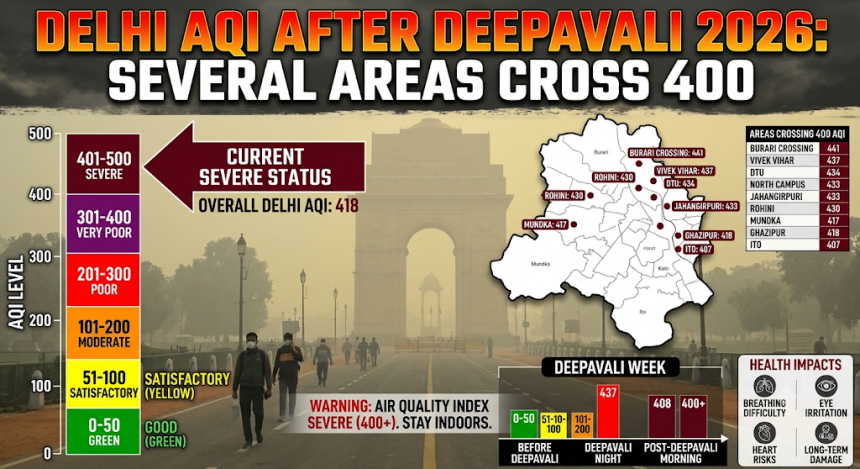
Data from the Central Pollution Control Board (CPCB) shows that several monitoring stations across Delhi logged worrying numbers on Monday morning. DTU and Burari Crossing both recorded an AQI of 437, which lands them squarely in the severe category.
Bawana, Jahangirpuri, Sonia Vihar, Punjabi Bagh, Okhla and Rohini were also breathing severe air. ITO recorded an AQI of 406 at around 4:20 am, and Chandni Chowk and Mundka crossed 400 in the early updates too. You could see the pollution just by stepping outside. A thick layer hung over roads and residential areas, and some well-known spots were half-hidden behind the grey haze.
Delhi AQI Category: What Do the Numbers Mean?
India’s CPCB sorts air quality into six categories. The AQI tells you how polluted the air is and what that could mean for your health.
Here’s how the categories break down:
| AQI Range | Air Quality Category |
| 0–50 | Good |
| 51–100 | Satisfactory |
| 101–200 | Moderate |
| 201–300 | Poor |
| 301–400 | Very Poor |
| 401–500 | Severe |
Anything above 400 counts as severe, and it can be risky for everyone. Children, older adults and people with respiratory or heart conditions are the most vulnerable.
Firecrackers Add to Delhi’s Pollution After Deepavali
Firecracker smoke was one of the biggest reasons the air quality suddenly got worse after Deepavali. Even with restrictions in place, fireworks were reported in many parts of the capital on Sunday evening, including Pitampura, Burari, Mayur Vihar and parts of Lutyens’ Delhi.
Delhi’s average AQI reached 376 on Sunday. By 10 pm, 20 of the 59 monitoring stations had already entered the severe category. Sonia Vihar recorded the highest reading at 463, followed by Jahangirpuri at 450.
As the fireworks carried on through the evening, smoke settled over roads and neighbourhoods. People complained of poor visibility, the sharp smell of burnt crackers, itchy eyes, and trouble breathing.
Why Is Delhi’s Air Quality Getting Worse?
Firecrackers aren’t the whole story. Delhi deals with several sources of pollution, especially in winter.
Here are the main culprits:
- Firecracker emissions: Fireworks release particulate matter and other pollutants, which make already polluted air even worse.
- Vehicular emissions: Heavy traffic and the sheer number of vehicles keep harmful pollutants concentrated across the city.
- Stubble burning: Crop-residue burning in neighbouring states, especially Punjab and Haryana, can add to pollution in the national capital region.
- Construction dust: Construction sites and dusty roads add to the particulate matter floating around.
- Unfavourable weather conditions: Low wind speeds, cooler temperatures and still air stop pollutants from dispersing.
The Air Quality Early Warning System says a low ventilation index and wind speeds below 10 kmph make it much harder for pollutants to clear out.
Delhi-NCR Pollution: Will AQI Remain Severe?
Unfortunately, the outlook isn’t great. The Air Quality Early Warning System has indicated that Delhi’s air could slip into the severe category during the day and stay dangerously high for the next few days. Firecracker smoke, vehicle emissions, stubble burning and unhelpful weather could keep piling pressure on the city’s air.
Stage III of the Graded Response Action Plan (GRAP) was already in force across Delhi-NCR ahead of Deepavali, as authorities tried to keep rising pollution in check. The situation has once again shown how badly Delhi needs stronger pollution-control measures and long-term fixes for its air.
How Can Residents Protect Themselves From Severe Air Pollution?
With severe AQI levels in several areas, it’s worth taking a few precautions to limit your exposure.
Here are some practical steps:
- Skip outdoor exercise, jogging and cycling while pollution levels are high.
- Wear a well-fitted N95 mask if you need to step out.
- Keep your windows and doors closed on heavily polluted days.
- Run an air purifier indoors if you have one.
- Avoid adding more smoke at home, such as cigarettes, incense or anything else that burns.
- Take extra care with children, older adults and anyone with existing respiratory conditions.
- See a doctor if you have a cough that won’t go away, difficulty breathing or chest discomfort.