

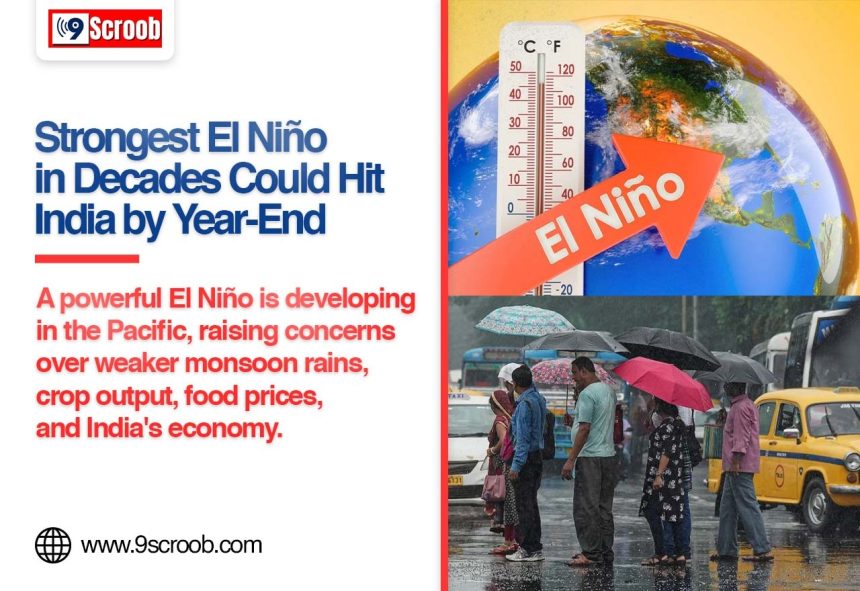
If you’ve been noticing that this year’s monsoon feels a little off, you’re not imagining things. Out in the Pacific, a massive El Niño is building, and forecasters are now saying it could turn into one of the strongest ever recorded, possibly by the time 2026 wraps up. For a country as tied to its monsoon as India is, that’s not a small thing.
El Niño 2026: Why Is the Pacific Warming So Quickly?
El Niño is part of a natural cycle called ENSO, where the surface waters of the central and eastern Pacific warm up beyond their usual range. It happens periodically, but this particular event has forecasters genuinely surprised by how fast it’s intensifying. NOAA’s latest outlook puts the odds at around 90% that this El Niño will rank among the strongest since record-keeping began in 1950, a sharp jump from the 81% chance they gave it just a month earlier.
Some climate models are painting an even more dramatic picture. Projections from the ECMWF show sea surface temperatures in the key monitoring region climbing toward 3°C above normal by December, with some scenarios pushing past 4°C, numbers that would blow past the previous record-holders from 2015-16 and 1997-98. As one climate scientist put it, models are essentially forecasting territory nobody has ever actually observed before.
Whether it fully lives up to that “strongest ever” billing is still uncertain; El Niño tends to peak in the Northern Hemisphere winter, so the real test comes over the next few months. But even the more conservative estimates agree this is shaping up to be a major event, sometimes referred to as a “Super El Niño.”
Why El Niño 2026 Matters for India’s Monsoon
For most of the world, El Niño mostly shows up as a headline about global temperature records. For India, it’s more personal; it goes straight at the monsoon, which supplies around 70% of the country’s annual rainfall and waters most of its farmland.
Here’s the basic mechanism: in a typical year, strong trade winds push warm Pacific water toward Asia, where it evaporates and eventually comes down as monsoon rain over India. El Niño disrupts that circulation. Warm water piles up in the central and eastern Pacific instead of moving west, weakening the atmospheric engine that normally drives India’s rains.
This isn’t a new relationship; India has felt it before. Looking back at data since 1951, roughly three out of every four moderate-to-severe El Niño years brought a real contraction in agricultural output, with rainfall during the monsoon dropping close to 10% on average and food-grain production for the kharif season falling nearly 6%.
India’s 2026 Monsoon Shows Early Signs of Weakness
The 2026 monsoon didn’t get off to a strong start. The IMD flagged a sizeable shortfall as early as mid-June, and by mid-month, cumulative rainfall was running well below normal nationally, with the northwest seeing a particularly steep deficit and central India not far behind. The IMD’s broader seasonal outlook points to total rainfall coming in at around 90% of the long-period average, which puts this year in below-normal territory, though not quite drought-level.
That gap matters because roughly 60% of India’s farmers depend directly on monsoon rain, and close to half the country’s farmland still has no reliable irrigation to fall back on. The kharif crops- rice, cotton, soybeans, pulses, and groundnut- are sown between June and October and rely almost entirely on these rains to get through their most vulnerable growth stages. A weak or erratic monsoon shortens the sowing window and lowers soil moisture right when crops need it most.
There’s also a knock-on cost: when the rain doesn’t show up, farmers turn to groundwater pumps to compensate, which pushes up diesel and electricity costs even as yields fall, a squeeze from both directions.
How a Weak Monsoon Could Affect India’s Economy
Agriculture only makes up around 18% of India’s GDP these days, but it still employs close to half the country’s workforce, so a bad monsoon doesn’t stay contained to rural incomes. Weaker harvests tend to show up later as food inflation, and some economists are already flagging that consumer price inflation could edge toward the 4.5–5% range next fiscal year if the rains stay weak.
It’s worth saying, though, that India’s relationship with El Niño has actually gotten less brutal over time. Data comparing the 1982–2002 period to the years since 2004 shows the number of El Niño events that seriously dented agricultural output has roughly halved. Better irrigation coverage, minimum support prices for farmers, and expanded crop insurance have all linked a weak monsoon and economic pain less automatically than it used to be. Rural households have also diversified; income from farming itself now makes up only about a third of total rural household earnings, with the rest coming from other sources.
Could the Indian Ocean Dipole Help India?
Not everything is stacked against India this year. The IMD has flagged the possible development of a positive Indian Ocean Dipole, a separate climate pattern in the Indian Ocean, later in the monsoon season. When it shows up alongside El Niño, a positive IOD can partially offset the drying effect, potentially giving August and September rainfall a bit of a boost. It’s not a guarantee, but it’s the kind of counterbalancing factor that’s kept some past El Niño years from turning into full-blown droughts.
El Niño 2026: What Happens Next for India?
Nobody is calling this a certain disaster for India, and there’s an important distinction to hold onto: El Niño raises the odds of a weak monsoon; it doesn’t guarantee one. Some of India’s worst drought years happened without any El Niño involved at all, and some El Niño years have passed without much drama.
That said, the ingredients this year- a genuinely powerful Pacific warming event, a monsoon that’s already starting below normal, and heavy dependence on rain-fed farming- are enough that agricultural economists and policymakers are treating this as a season worth watching closely rather than shrugging it off. The consensus emerging from climate researchers is less about panic and more about preparedness; the poor monsoon itself can’t be prevented at this point, but its worst effects on farmers, food prices, and water supply can still be softened with the right planning.
For now, all eyes are on how the Pacific behaves over the coming months, and whether that positive Indian Ocean Dipole shows up in time to take some of the edge off.