

A Routine Flight Turns Frightening
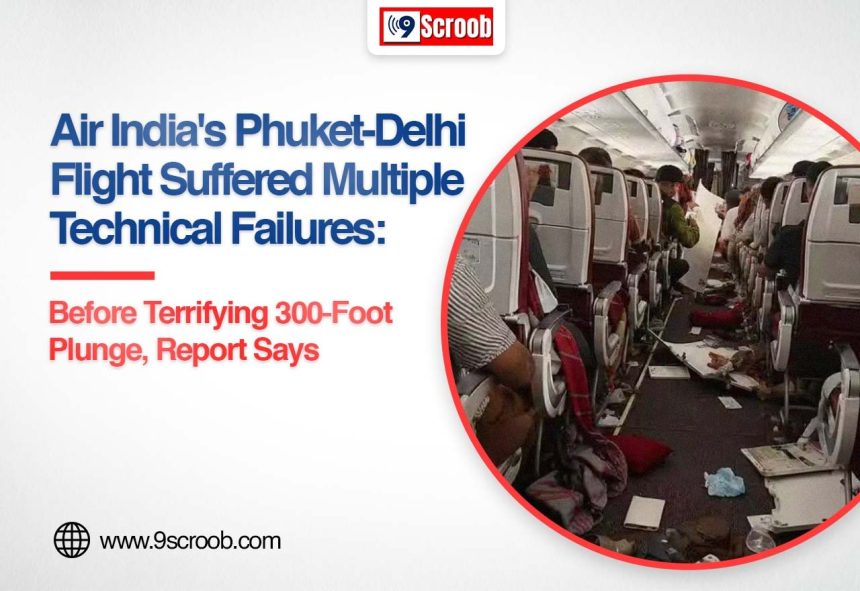
What began as an ordinary Phuket-to-Delhi journey turned into a mid-air scare for more than 130 passengers on August 4, when Air India flight AI2379 suddenly dropped 300 feet in altitude while cruising over Odisha. The Airbus A320 was carrying 137 passengers, including three infants, along with eight crew members — two pilots and six cabin crew.Twenty passengers and four cabin crew members were injured in the sudden drop before the aircraft stabilised and landed safely in Delhi.
At first, the incident looked like a case of routine turbulence — something commercial flights encounter regularly. But as investigators dug deeper, the story became more complicated, and considerably more serious.
From “Turbulence” to “Serious Incident”
Air India initially attributed the sudden altitude loss to turbulence.That explanation didn’t hold for long. he Directorate General of Civil Aviation (DGCA) has since classified the event as a “serious incident,” with India’s Aircraft Accident Investigation Bureau (AAIB) now leading a formal probe under the International Civil Aviation Organization’s Annex 13 framework— the same international protocol used for major aviation accident investigations.
Given the scale of scrutiny, he AAIB is receiving technical assistance from Airbus, the aircraft’s manufacturer, along with France’s Bureau of Enquiry and Analysis for Civil Aviation Safety (BEA). Teams from both organizations are helping investigators comb through the aircraft’s technical systems and recorded flight data to pin down exactly what went wrong.
What the Maintenance Report Reveals
The most striking new detail to emerge is a purported post-flight maintenance report for the aircraft involved — an Airbus A320 registered as VT-EXO. According to that document, the flight was far from problem-free before the altitude drop occurred.
The report lists repeated low-pressure alerts across the green, blue, and yellow hydraulic systems, along with low fluid levels recorded in the yellow and blue hydraulic reservoirs. Hydraulic systems on commercial aircraft are critical — they power everything from landing gear to flight control surfaces, and having issues flagged across three separate systems in one flight is unusual.
That’s not all. The same report notes that the aircraft recorded two separate autopilot disconnections during the flight, along with additional warnings related to faults in the left and right elevator flight controls. Elevators control the aircraft’s pitch — the up-and-down movement of the nose — making any fault in that system directly relevant to a sudden, unexplained altitude change. Taken together, it’s a troubling list of red flags for a single flight. But investigators are being careful not to jump to conclusions.
The Crucial Caveat
Despite how alarming the technical warnings sound, officials have stopped short of directly linking them to the 300-foot plunge. The maintenance report does not establish a direct connection between the technical warnings and the aircraft’s sudden loss of altitude, nor does it confirm whether there was an actual loss of hydraulic pressure or fluid during the flight.
In other words, the warnings were logged — but whether they actually caused, contributed to, or were unrelated to the altitude drop is still an open question. Investigators are working to establish whether the incident was linked to the reported technical failures, turbulence, crew actions, or some combination of these factors.
A Complication: The Pilot Screening Controversy
Adding another layer to an already complex investigation, the technical findings have emerged alongside an earlier controversy involving an initial screening of the pilot-in-command for psychoactive substances, which reportedly returned a positive result and prompted a confirmatory test.
That detail has added scrutiny to the crew’s role in the incident, running parallel to the mechanical investigation. Whether the two threads — technical faults and the pilot screening — connect in any way is something investigators have yet to clarify publicly.
Part of a Bigger Pattern
This incident hasn’t happened in isolation. Air India has faced a string of technical and safety-related episodes over the past year, following the fatal AI171 crash in Ahmedabad in June 2025 that killed 260 people. Just two days after that crash, another Air India flight — this time from Delhi to Vienna — reportedly plunged nearly 900 feet mid-air, prompting its own DGCA investigation and drawing attention to what regulators described as ongoing maintenance and defect-rectification concerns across the airline’s fleet.
Whether or not the Phuket-Delhi incident turns out to be linked to those earlier concerns, it’s added fresh pressure on Air India at a time when the airline is already under close public and regulatory watch.
What Comes Next
For now, the AAIB’s investigation continues, with Airbus and BEA experts assisting in the technical review. A clearer picture — including whether the hydraulic and autopilot faults actually caused the altitude drop — is expected once investigators complete their analysis of the flight data recorders and cockpit systems.
Until then, the incident stands as another reminder of the intense scrutiny facing Indian aviation safety standards, and of how much can still go wrong on a flight that, for its passengers, felt routine right up until it wasn’t.